instance_seg_keypoint_visualizer
最后更新
luxonis_train.attached_modules.visualizers.instance_seg_keypoint_visualizer在同一图像上绘制实例掩码、边界框和关键点。类
InstanceSegKeypointVisualizer
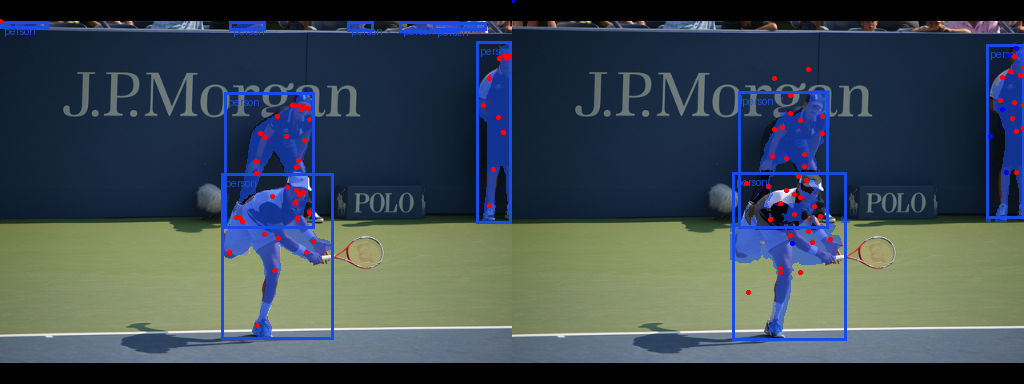
输入::prediction_canvas,target_canvas(Tensor): [B, 3, H, W]boundingbox(list[Tensor]): 每张图像 [Mi, 6],[x1, y1, x2, y2, conf, class],像素instance_segmentation(list[Tensor]): 每张图像 [Mi, H, W],二进制keypoints(list[Tensor]): 每张图像 [Mi, nkeypoints, 3],(x, y, conf),像素target_boundingbox(Tensor | None): [N, 6],[batch, class, x, y, w, h],xywh归一化target_instance_segmentation(Tensor | None): [N, H, W],每个目标框一个target_keypoints(Tensor | None): [N, 1 + 3**n*keypoints],[batch, x, y, v, ...],归一化
输出::Tensor | tuple[Tensor, Tensor]: [B, 3, H, W],当给定任何目标时,为(targets, predictions)对
参考
- 来源:本项目。
- 许可证:Apache-2.0 (本项目)
注意
调用 InstanceSegmentationVisualizer 的绘图方法来绘制掩码和边界框,然后调用 KeypointVisualizer 的绘图方法在其上方绘制关键点。视觉化工具存储
fill、font 和 font_size 选项,但不使用它们。示例
节点
visualizers 列表中的一个条目:Yaml
1- name: InstanceSegKeypointVisualizer方法
init
Python
1def __init__(labels: dict[int, str] | list[str] | None = None, draw_labels: bool = True, draw_scores: bool = False, colors: dict[str, Color] | list[Color] | None = None, fill: bool = False, width: int | None = None, font: str | None = None, font_size: int | None = None, alpha: float = 0.6, visibility_threshold: float = 0.5, connectivity: list[tuple[int, int]] | None = None, visible_color: Color = 'red', nonvisible_color: Color | None = None, radius: int | None = None, draw_indices: bool = False, **kwargs):labels(dict[int, str] | list[str] | None): 要绘制的类名。字典将类索引映射到名称。列表按位置映射。当为None或空时,名称来自节点的classes,因此视觉化工具需要一个node。draw_labels(bool): 是否在每个框旁边绘制类名。适用于预测和目标。draw_scores(bool): 是否在每个预测框的标签中写入其置信度,保留两位小数。仅适用于预测。如果没有draw_labels,标签就是置信度本身。colors(dict[str, Color] | list[Color] | None): 掩码和框的颜色。字典将类名映射到颜色。列表按类索引映射。当为None时,每个类都会从 get_color 获取一个不同的颜色,并以其索引作为种子。fill(bool): 绘图方法不读取它。width(int | None): 框的线宽,以像素为单位。当为None或0时,宽度是较小画布边长百分之一,向下取整,且至少为1。font(str | None): 绘图方法不读取它。font_size(int | None): 绘图方法不读取它。alpha(float): 掩码的不透明度,从0(透明)到1(不透明)。visibility_threshold(float): 可见预测关键点的最低置信度。KeypointVisualizer.draw_predictions 说明了视觉化工具如何绘制其他关键点。connectivity(list[tuple[int, int]] | None): 用线连接的关键点索引对,即骨架。适用于预测和目标。None不绘制线条。visible_color(Color): 可见预测关键点和所有目标关键点的颜色。nonvisible_color(Color | None): 低于visibility_threshold的预测关键点的颜色。当为None时,视觉化工具不会在它们的坐标处绘制它们。radius(int | None): 关键点的半径,以像素为单位。当为None时,forward 会根据每个画布的大小选择它。draw_indices(bool): 是否在每个关键点旁边写入其索引。KeypointVisualizer.draw_targets 说明了何时这会为目标关键点引发RuntimeError。**kwargs: 转发给 BaseVisualizer 的关键字参数,例如scale和node。
forward
Python
1def forward(prediction_canvas: Tensor, target_canvas: Tensor, boundingbox: list[Tensor], instance_segmentation: list[Tensor], keypoints: list[Tensor], target_boundingbox: Tensor | None, target_instance_segmentation: Tensor | None, target_keypoints: Tensor | None) -> tuple[Tensor, Tensor] | Tensor:target_canvas 开始:- 当
target_boundingbox和target_instance_segmentation都设置时,InstanceSegmentationVisualizer.draw_targets 绘制掩码和边界框。 - 当
target_keypoints设置时,KeypointVisualizer.draw_targets 在其上方绘制关键点,颜色为visible_color。
radius 为 None 时,半径来自每个画布的大小。当两边都小于 96 像素时为 1,当一边大于 512 像素时为 5,否则为 2。示例
Pycon
1>>> import torch
2>>> visualizer = InstanceSegKeypointVisualizer(
3...     labels=["person"], colors=["red"]
4... )
5>>> canvas = torch.zeros(1, 3, 16, 16, dtype=torch.uint8)
6>>> boxes = [torch.tensor([[4.0, 4.0, 12.0, 12.0, 0.9, 0.0]])]
7>>> masks = torch.ones(1, 16, 16, dtype=torch.uint8)
8>>> keypoints = [torch.tensor([[[8.0, 8.0, 0.9]]])]
9>>> args = (canvas, canvas, boxes, [masks], keypoints)
10>>> visualizer(*args, None, None, None).shape
11torch.Size([1, 3, 16, 16])
12>>> targets = torch.tensor([[0, 0.5, 0.5, 2.0]])
13>>> len(visualizer(*args, None, None, targets))
142prediction_canvas(Tensor): 形状为[B, 3, H, W]的uint8图像,用于绘制预测。target_canvas(Tensor): 形状为[B, 3, H, W]的uint8图像,用于绘制目标。boundingbox(list[Tensor]): 每张图像一个张量,形状为[M_i, 6],行格式为[x1, y1, x2, y2, conf, class],以像素为单位。instance_segmentation(list[Tensor]): 每张图像一个张量,形状为[M_i, H_0, W_0],每个框一个二进制掩码。H_0和W_0是scale调整大小前的图像大小。keypoints(list[Tensor]): 每张图像一个张量,形状为[M_i, K, 3]。每个关键点为(x, y, confidence),x和y以像素为单位。target_boundingbox(Tensor | None): 形状为[N, 6]的框,行格式为[batch_index, class, x, y, w, h],xywh归一化到[0, 1]。当批次没有boundingbox标签时为None。target_instance_segmentation(Tensor | None): 形状为[N, H_0, W_0]的二进制掩码,每个目标框一个。当批次没有instance_segmentation标签时为None。target_keypoints(Tensor | None): 形状为[N, 1 + 3 * K]的关键点,行格式为[batch_index, x_1, y_1, v_1, ..., v_K]。坐标归一化到[0, 1]。当批次没有keypoints标签时为None。
tuple[Tensor, Tensor] | Tensor: 当设置了三个目标中的任何一个时,返回绘制图像的(targets, predictions)对;否则只返回预测图像。当只设置了target_boundingbox和target_instance_segmentation中的一个,且target_keypoints为None时,目标图像就是target_canvas本身。